Zcash Privacy: Why Your Transactions Are Not Invisible
Real-world limitations of Zcash privacy.
 4343
4343 
In a crypto market that many believed had grown saturated, one beacon of revival stands out: Zcash (ZEC). By late 2025, ZEC had surged over 400–500 % year-to-date, climbing from well under $100 to above $500 by December. Its market-capitalization crossed the $10 billion mark and, for the first time, overtook longtime privacy-leader — Monero.
Privacy is back. Hackers, fraud rings, and on-chain analysts can now trace almost any transaction made by everyday users or businesses. This level of visibility exposes wallets, financial flows, and even physical identities — putting funds and, in extreme cases, personal safety at risk.
Users have increasingly turned their attention to Zcash as a privacy-focused cryptocurrency. But here’s the catch: despite its cutting-edge zero-knowledge-proof technology (zk-SNARKs), Zcash’s real-world privacy falls far short of what it promises.
In this article, we’ll dive into how Zcash’s privacy architecture really works, where it fails, and what that means for users that believed they were invisible.
Key Takeways
- In Zcash, privacy is optional, not the default. Most transactions still go through fully transparent addresses — just like Bitcoin.
- True privacy only happens when funds move strictly between z-addresses. In reality, those transfers are pretty rare.
- Less than a quarter of all ZEC is actually shielded. Because the private pool is so small, shielded transactions stand out and are easier to trace.
- UPD 12/09/2025: Arkham de-anonymized more than 53% of all Zcash transactions. One of the largest holders of the cryptocurrency turned out to be the U.S. government.
- Even if z→z transfers are always used, repeated addresses, identical amounts, send times, and filled memo tags give the user away.
How Zcash Privacy Works and Where It Breaks in Real Life
Zcash was created as a privacy-first fork of Bitcoin, powered by zk-SNARKs, a form of zero-knowledge proofs capable of hiding the sender, receiver, and transaction amount. On paper, it is one of the most advanced cryptographic privacy systems in any public blockchain. In practice, however, Zcash’s privacy depends far less on cryptography and far more on how users, wallets, and exchanges actually handle ZEC.
Two Address Types: Transparent vs. Shielded
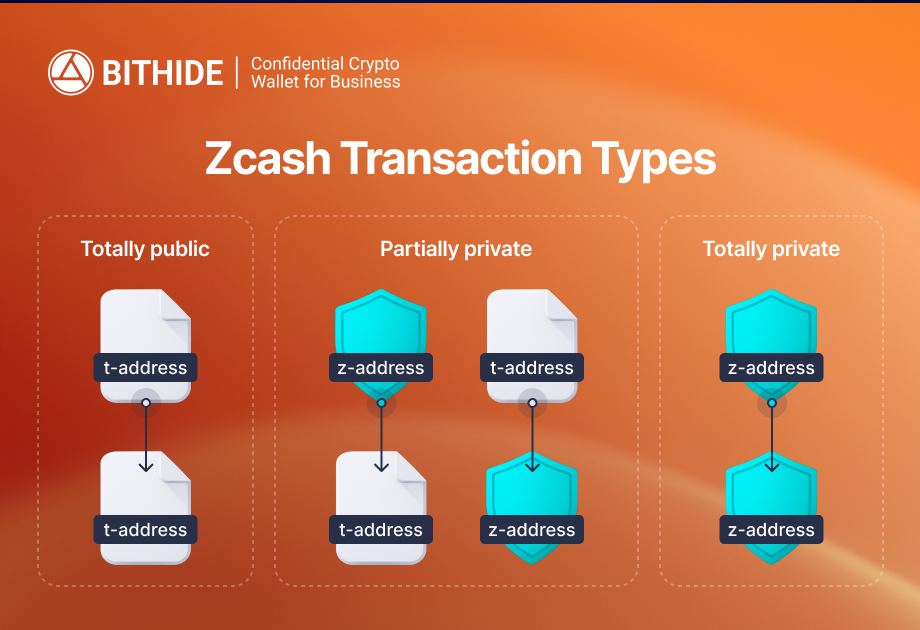
Zcash operates with two fundamentally different address formats:
- t-addresses (transparent) — fully public, identical to Bitcoin’s transparency model.
- z-addresses (shielded) — private, where zk-SNARKs conceal all transaction details.
True confidentiality is only achieved in z → z transactions. Yet the ecosystem defaults heavily toward transparency:
- Most centralized exchanges only support t-address deposits and withdrawals.
- Many mobile wallets use transparent addresses by default.
- Mixed flows like t → z → t still leak patterns, amounts, and timing metadata.
As a result, even though Zcash offers strong cryptography, the majority of ZEC activity never becomes private at all.
Technical Limitations of Zcash Privacy
The privacy model around ZEC has several structural limitations that affect how protected users actually are — even when transactions are shielded.
Privacy in Zcash Is Optional, Not Guaranteed
Unlike Monero, where every transaction is private by design, Zcash leaves privacy as a choice. Users can transact through either transparent (t) or shielded (z) addresses, and most wallets, exchanges, and mobile apps default to the transparent option.
A Small Shielded Pool Reduces Anonymity
By the end of 2025, the shielded pool still accounts for a minority of ZEC activity — roughly 20–25 % of the total supply. This doesn’t break the cryptography, but it weakens the anonymity it provides. When only a small percentage of users transact privately, shielded operations stand out. Analysts can more easily correlate the few shielded transactions with their transparent entry and exit points, or spot rare patterns that would disappear in a larger pool.
Patterns Matter More Than zk-SNARKs
Even completely shielded transactions can be deanonymized when external patterns leaks. Wallet reuse, regular timing patterns, predictable transaction amounts, memo fields, and user actions around the shielded pool often reveal more than the protocol hides.
In other words, privacy in Zcash depends heavily on operational behavior — and most users don’t maintain the discipline required to stay anonymous.
The Ecosystem Around Zcash Is Not Built for Privacy
While the protocol supports private transfers, the surrounding ecosystem works against it. Most exchanges require t-addresses, and some wallets log metadata or expose timing information. These factors create a trail that can be linked together even without decrypting any shielded data.
Network-Layer Exposure Remains a Critical Weak Point
Zcash does not hide IP addresses. When a wallet broadcasts a shielded transaction, the sender’s IP address is exposed to the network. It goes to a node, and many nodes are controlled by hackers or fraudsters. A VPN won’t help — user data often leaks into the network through hacks or is sold by dishonest employees.
This has been one of the most common real-world deanonymization methods: investigators follow the network footprint, not the zero-knowledge proofs.
UPD 12/09/2025: Arkham Deanonymized Over 53% of All Zcash Transactions
The analytics platform Arkham has deanonymized more than 53% of all Zcash transactions, totaling $420 billion, including both public and private ones. Over 48% of inputs and outputs have been linked to identifiable entities, including well-known individuals and organizations.
One of the largest holders of Zcash turned out to be the US government — in 2018, authorities seized ZEC worth approximately $737,000 from AlphaBay darknet market founder Alexandre Cazes. Over the years, the value of these assets has roughly doubled.
Zcash creator Zooko Wilcox partially disputed Arkham analysts' claims. According to the developer, the platform has not deanonymized “a single ZEC” stored in shielded pools, as this is simply impossible.