Corporate Crypto Wallet Comparison: BitHide, Fireblocks, CoinPayments and NOWPayments
How to Choose Crypto Infrastructure for Business in 2026.
 109
109 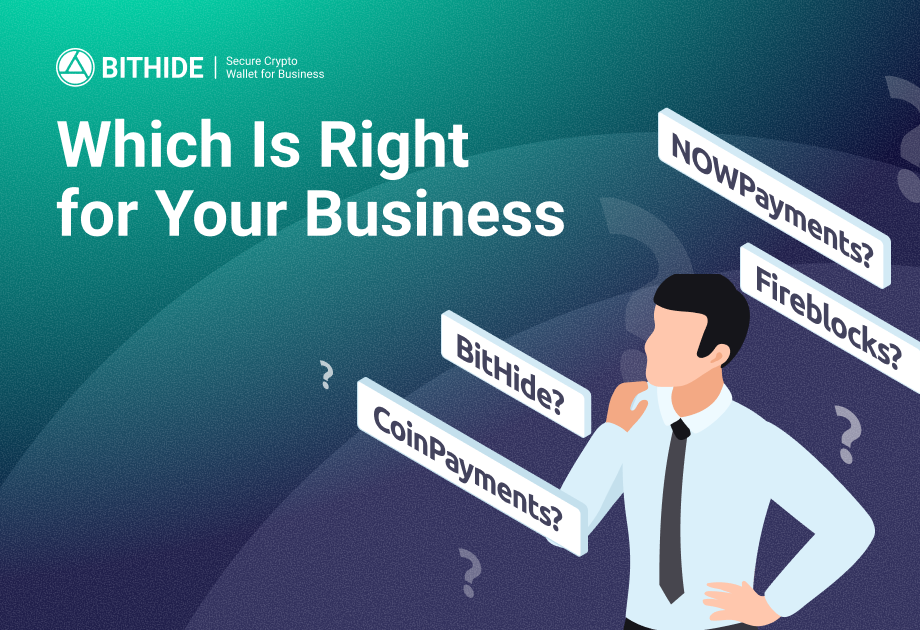
Choosing crypto infrastructure for your business is a decision that is difficult to reverse later. Switching providers means migrating keys, reconfiguring all integrations, and going through a period during which both the old and new solutions must operate in parallel. At the same time, the market offers services and products built on fundamentally different architectures: from fully cloud-based solutions to software deployed on the client's own server, and the differences between them are not always obvious from providers' documentation.
We compared four solutions — BitHide, Fireblocks, CoinPayments, and NOWPayments — across three key criteria: control over infrastructure and assets, security architecture, and the level of operational automation. This article provides a detailed analysis of each criterion, summary tables, and recommendations for choosing the right solution based on your business type.
Criterion #1. Infrastructure Control
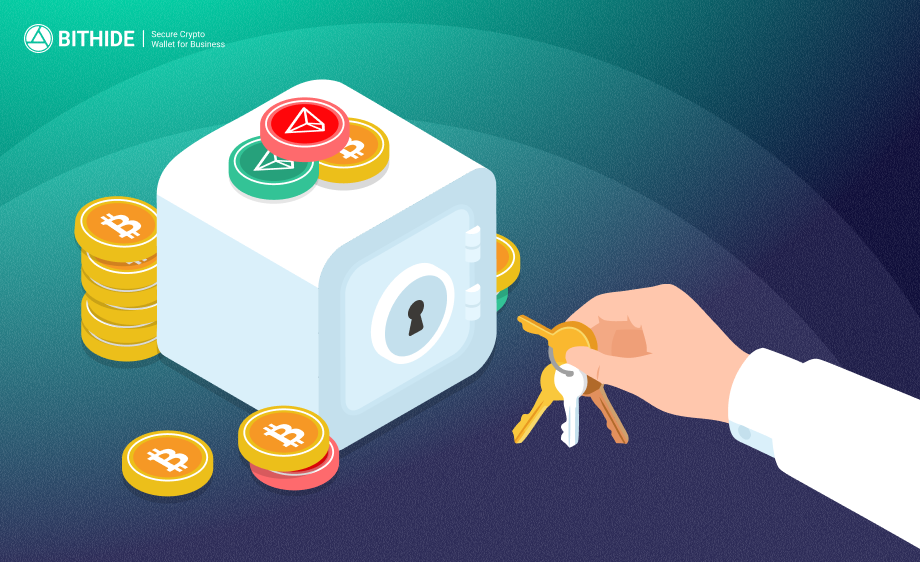
When choosing an enterprise crypto wallet, it is important to understand exactly what you will be able to control. This includes private keys, the seed phrase, operational data, event logs, security settings, and the environment in which the wallet operates.
When comparing enterprise solutions, it is important not to confuse two different characteristics:
- Non-custodial model — only you control the seed phrase and private keys, and therefore your digital assets.
- Self-hosted architecture — the software runs on your own infrastructure, meaning only you control the environment and operational data.
These are independent characteristics. A solution can be non-custodial while still operating as a cloud service. Conversely, a self-hosted wallet may use different key management models.
BitHide — Non-Custodial and Self-Hosted
The seed phrase is generated randomly and is never stored anywhere. Private keys are derived only at the moment a transaction is signed, exist for only a few seconds, and are then permanently removed. The software is deployed on your own server, and no third party has access to your assets or operational data, including transaction history, event logs, user settings, security policies, or internal business processes.
This approach is chosen by companies that treat crypto payments as part of their core infrastructure and do not want to delegate control over critical components to an external provider.
Fireblocks — Cloud-Based MPC Platform
Fireblocks is built as a cloud-based SaaS platform and uses MPC (Multi-Party Computation) to protect digital assets. The platform's core components, including transaction management and security policy enforcement, operate within Fireblocks' cloud infrastructure.
For large organizations, hybrid deployment options are available, allowing selected key shares to be stored within the customer's own infrastructure. However, fully self-hosted deployment of the platform is not available — the control layer remains in the Fireblocks cloud.
CoinPayments — Cloud-Based Payment Gateway
The service operates under a traditional custodial model: merchant funds are stored in wallets managed by the platform by default until they are withdrawn. Self-hosted or on-premises deployment is not offered in the public documentation — the product is available only as a cloud-based SaaS service.
For businesses, this means faster deployment. However, control over the operational infrastructure, platform logs, and runtime environment remains with the provider.
NOWPayments — Hybrid Custody Model
The platform supports both non-custodial and custodial operating modes. For new accounts without a connected payout wallet, custodial balance management is enabled by default. Self-hosted or on-premises deployment is not available — NOWPayments is offered exclusively as a cloud-based service.
Summary Table: Infrastructure Control
| Parameter | BitHide | Fireblocks | CoinPayments | NOWPayments |
| Custody model | Non-custodial — the seed phrase is stored only by the client; private keys are derived at the time of the transaction and immediately removed | MPC — the key is split into multiple shares; for large customers, some shares can be stored within their own infrastructure | Custodial — funds are stored by default in wallets managed by the platform | Hybrid — non-custodial or custodial, depending on the selected mode; for new accounts without a connected payout wallet, custodial mode is enabled by default |
| Self-hosted (runtime environment) | Yes — the software runs on the client's own server | No — the control layer remains in the Fireblocks cloud (only some key shares can be moved to customer infrastructure) | No — cloud-based SaaS only | No — cloud-based service only |
| Control over operational data (logs, event records, settings, security policies) | Controlled by the client — no third party has access | Controlled by the provider | Controlled by the provider | Controlled by the provider |
Criterion #2. Enterprise Asset Security
The security of an enterprise crypto infrastructure consists of multiple layers. Data protection, access control, user authentication, and operational approval workflows are often just as important as the mechanisms used to store digital assets. When evaluating a solution, it is therefore important to assess the entire security architecture rather than individual features.
BitHide — AES-256, MFA, RBAC, Payment Approval Levels, and Callback Hashing
BitHide's security architecture is built on a layered security model, where each mechanism is responsible for a specific stage of working with digital assets — from data storage to transaction approval.
Transaction history is backed up in real time and stored in your cloud in an AES-256 encrypted format. Today, this level of encryption is considered virtually impossible to break. If your server is physically destroyed, the wallet can be restored from the backup on new hardware exactly as it appeared at the moment of the last backup.
To secure communication with external systems, BitHide supports callback hashing, allowing the receiving application to verify that a notification was actually sent by your wallet and was not modified during transmission.
Access management is based on Role-Based Access Control (RBAC). Administrators can assign different roles to users and grant only the permissions required for their responsibilities. This helps enforce the principle of least privilege and reduces the risk of accidental or unauthorized actions.
Multiple authentication factors are supported to protect user accounts:
- Secret key.
- 2FA.
- Email.
- Server address.
- PIN code.
- Device Fingerprint.
BitHide also supports transaction approval workflows. For example, small payments can be processed automatically, while larger transactions require approval from a manager and the CFO. This allows companies to maintain control over critical payments without burdening executives with approving routine transactions.
Fireblocks — MPC, MFA, RBAC, Policy Engine, and Payment Approvals
Fireblocks builds its security architecture around Multi-Party Computation (MPC), replacing the traditional model of storing a single private key. Instead, multiple cryptographic key shares are used to authorize transactions, reducing the risk associated with compromising a single component.
The platform supports Role-Based Access Control (RBAC), allowing organizations to separate employee responsibilities and manage access to operations and digital assets. It also provides flexible security policies through its Policy Engine, enabling companies to define custom transaction rules.
To protect user accounts, Fireblocks supports multi-factor authentication (2FA and push notifications through the mobile application), as well as multi-level Approval Workflows that allow payments to require authorization from multiple employees or automatically enforce internal company policies.
CoinPayments — 2FA, IP Whitelisting, and API Protection
CoinPayments provides the standard security mechanisms commonly found in cloud-based payment platforms.
To protect account access, the platform supports two-factor authentication (2FA), and user permissions can be distributed across multiple accounts within a business profile. The primary focus is on securing the service itself and protecting access to customer accounts.
For many businesses, CoinPayments provides an adequate level of security for accepting cryptocurrency payments. However, it is not positioned as a platform for implementing complex enterprise-grade access management or multi-level transaction approval processes.
NOWPayments — 2FA, Webhook Signature Verification, and API Protection
To protect user accounts, the platform supports two-factor authentication (2FA). For webhook notifications, the service uses request signature verification, allowing the receiving system to confirm that a notification was actually sent by NOWPayments and was not modified during transmission.
The platform is primarily designed to automate cryptocurrency payment acceptance. As a result, its public documentation does not describe enterprise-grade Role-Based Access Control (RBAC) or built-in multi-level payment approval workflows.
Summary Table: Enterprise Asset Security
| Parameter | BitHide | Fireblocks | CoinPayments | NOWPayments |
| Data encryption | Yes — AES-256 encryption | MPC (the key is split into cryptographic shares) | Not specified* | Not specified |
| MFA | Yes — secret key, 2FA, email, server address, PIN code, device fingerprint | Yes — 2FA and push notifications in the mobile app | Partial — 2FA | Partial — 2FA |
| RBAC | Yes | Yes | Not specified | Not specified |
| Payment approval levels | Yes — configurable thresholds (small payments processed automatically, larger payments approved by a manager or CFO) | Yes — Approval Workflows | Not specified (the platform is not positioned for complex approval workflows) | Not specified |
| Callback hashing | Yes | Not specified | Not specified | Yes — webhook request signature verification |
* "Not specified" means the feature is not confirmed in the publicly available documentation. It does not necessarily mean the feature is unavailable.
Criterion #3. Operational Automation

As the volume of cryptocurrency transactions grows, so does the number of routine operational tasks. Processing incoming payments, handling recurring payouts, managing network fees, generating new wallet addresses, and exchanging data with internal systems can consume significant time when performed manually.
When choosing a crypto payment solution for your business, it is therefore important to evaluate not only the availability of an API, but also the level of automation built into day-to-day operations. The fewer manual actions employees need to perform, the lower the operational costs and the lower the risk of human error.
BitHide — Mass Payments, Auto-Withdrawals, and Lower TRON Network Fees
BitHide is designed for companies that process a high volume of cryptocurrency transactions every day. To reduce routine operational work, the solution provides:
- Mass payments — send funds to multiple recipients simultaneously in a single operation.
- Rule-based auto-withdrawals.
- Integration with your systems through the API, payment pages, or a customizable payment widget. Unlike cloud-based solutions, BitHide is deployed within the client's infrastructure, so the API and all operational data remain inside the corporate environment.
- Proxy Payments, where the amount required for a transfer is automatically consolidated from multiple wallet addresses into a temporary one-time address and then sent to the recipient as a single transaction.
- Automatic generation of unique payment addresses.
- Blockchain fee payments through temporary service addresses (Gas Stations).
- The ability to pay blockchain fees directly from the billing balance, making costs easier to predict and simplifying financial planning.
- Easy generation of financial reports for accounting.
- Optional automatic AML screening of all incoming digital assets.
In addition, transaction fees on the TRON network can be reduced through TRON Energy rental, allowing businesses to save up to 50% on USDT TRC-20 transaction costs.
Fireblocks — AML Screening, Mass Payments, and Gas Management
Fireblocks also provides extensive automation for cryptocurrency operations. The platform supports mass payments (Batch Transactions), automatic fund consolidation through the Policy Engine, deposit address generation, and gas fee management through Gas Stations.
Fireblocks offers a comprehensive integration infrastructure that includes a REST API, official SDKs, Webhooks, a Co-signer for automated transaction signing, Web3 development tools, and a dedicated sandbox environment for development and testing.
For financial operations, Fireblocks provides reporting capabilities and integrations with AML providers for transaction screening. Gas Stations automatically replenish balances used to pay transaction fees on Ethereum and EVM-compatible networks.
A built-in TRON Energy rental mechanism for reducing USDT TRC-20 transaction costs is not described in Fireblocks' public documentation.
CoinPayments — Mass Payments, Auto-Sweep, and Basic AML Filtering
CoinPayments is designed for businesses that need to accept cryptocurrency payments through a ready-to-use cloud infrastructure. The platform's automation focuses primarily on payment processing and withdrawals rather than advanced enterprise crypto infrastructure management.
The platform supports mass payments as well as Auto-Sweep, which automatically withdraws or converts the balance of a specific cryptocurrency once a predefined threshold is reached. CoinPayments can automatically generate payment addresses and send notifications when funds are received. Transaction history can be exported in CSV format for further processing and accounting.
CoinPayments provides a REST API for external integrations, uses HMAC request signing and IPN notifications, supports ready-made plugins for popular e-commerce platforms, and offers testing through the Litecoin Testnet.
CoinPayments does not provide built-in blockchain fee management tools such as Gas Stations. For ERC-20 and TRC-20 transactions, businesses must manually maintain sufficient native token balances on wallet addresses to cover network fees. TRON Energy rental for reducing USDT TRC-20 transaction costs is also not described.
NOWPayments — Automatic Address Generation and Targeted AML Screening
NOWPayments combines cryptocurrency payment acceptance and payouts within a single platform. Its automation is focused primarily on payment workflows, including accepting payments, mass payments, and simplifying high-volume transaction processing.
The platform automatically generates unique payment addresses. It also allows multiple incoming payments to be consolidated into a single outgoing transaction, helping reduce the number of on-chain operations.
NOWPayments provides a REST API, webhook notifications, ready-made libraries and plugins, separate JWT authentication for payout operations, and a testing environment where developers can simulate different payment scenarios without using test cryptocurrencies.
The platform does not provide rule-based automatic withdrawals or gas management tools. It also does not offer built-in TRON Energy rental to reduce USDT TRC-20 transaction costs. Payment history can be used for reporting and data exports, although a dedicated financial reporting module for accounting is not described. AML screening is performed through blockchain analytics provided by partner services, while suspicious transactions may be suspended for additional review.
Comparison Table: Operational Automation
| Parameter | BitHide | Fireblocks | CoinPayments | NOWPayments |
| Mass payments | Yes | Yes — Batch Transactions | Yes | Yes |
| Rule-based auto-withdrawals | Yes | Not specified separately (only fund consolidation through the Policy Engine) | Yes — Auto-Sweep based on thresholds | Not described |
| Integration | API, payment page, customizable widget | REST API, official SDKs, Webhooks, Co-signer, Web3 tools, sandbox environment | REST API, HMAC request signing, IPN, ready-made e-commerce plugins, Litecoin Testnet | REST API, webhooks, ready-made libraries and plugins, separate JWT authentication for payouts, testing environment with scenario simulation |
| Automatic fund consolidation | Yes — via Proxy Payments | Yes — through the Policy Engine | Not presented as a separate feature (may overlap with Auto-Sweep) | Yes — consolidates incoming payments into a single outgoing transaction |
| Automatic generation of unique addresses | Yes | Yes | Yes | Yes |
| Gas management | Yes — Gas Stations + billing balance fee payments + TRON Energy rental (up to 50% savings on USDT TRC-20) | Partial — Gas Stations for Ethereum and EVM-compatible networks only; TRON Energy rental is not described | No — customers must manually maintain ERC-20/TRC-20 network fee balances; TRON Energy rental is not described | No — no gas management tools or TRON Energy rental |
| Reporting | Yes | Yes | Partial — CSV export of transaction history only | Partial — payment history is available, but no dedicated reporting module |
| Automatic AML screening | Yes | Yes | Described as part of the AML/KYC framework; the screening mechanism and provider are not disclosed | Partial — reactive screening through partner services; only transactions flagged as suspicious are reviewed |
Which Solution Should You Choose?
BitHide — If You Need Maximum Control Over Infrastructure and Keys
Best suited for companies that view crypto payments as part of their core infrastructure rather than as an outsourced service, including PSPs, fintech companies, EMIs, and organizations willing to deploy and operate the solution on their own servers in exchange for complete control over data, keys, and operational processes.
Strengths
- Both self-hosted and non-custodial — private keys exist only during transaction signing and are never stored.
- Multi-layered security (AES-256, six-factor MFA, RBAC, configurable payment approval levels, callback hashing).
- End-to-end automation — mass payments, rule-based auto-withdrawals, Gas Stations, blockchain fee payments from the billing balance, built-in financial reporting, and optional automatic AML screening of all incoming digital assets.
- Save up to 50% on USDT TRC-20 transaction fees through TRON Energy rental.
Weaknesses
The self-hosted model requires infrastructure resources for deployment and maintenance. Unlike cloud-based platforms, getting started involves more than simply generating an API key in five minutes.
Fireblocks — If You Need Institutional Infrastructure with Flexible Key Placement
Best suited for banks and large financial institutions with multi-level approval workflows that require a mature MPC platform with a built-in Policy Engine rather than building their own infrastructure from scratch.
Strengths
- MPC architecture with the ability to store selected key shares in your own HSM or cloud infrastructure.
- Mature Policy Engine and Admin Quorum for multi-level approval workflows.
- Extensive automation (Mass Payments via Batch Transactions, fund consolidation through the Policy Engine, integrated reporting, and AML screening through partner providers).
- Transaction approval through the mobile application in addition to mandatory 2FA.
Weaknesses
- The platform's control layer remains in the Fireblocks cloud — fully self-hosted deployment is not available.
- Gas Stations support only Ethereum and EVM-compatible networks. Automated fee management for TRON is not described.
CoinPayments — If You Need to Start Accepting Crypto Payments Quickly Without Your Own Infrastructure
Best suited for small and mid-sized e-commerce businesses where deployment speed is more important than infrastructure control.
Strengths
- Simple integration through ready-made plugins for popular e-commerce platforms.
- Automated payouts — mass payments and Auto-Sweep based on predefined thresholds.
Weaknesses
- Fully custodial model — keys and funds remain under the platform's control until withdrawal.
- No self-hosted deployment option.
- No built-in gas management — businesses must manually maintain native token balances to pay ERC-20 and TRC-20 network fees.
- Public documentation does not disclose technical details about data encryption or the AML screening mechanism.
NOWPayments — If You Need a Single Platform for Payment Acceptance and Payouts with a Flexible Custody Model
Best suited for businesses that want to combine payment acceptance and payouts within one platform and are willing to configure their payout wallet manually to control where funds are sent.
Strengths
- Choice between custodial and non-custodial modes.
- Convenient testing environment with payment status simulation that does not require real cryptocurrency.
- Consolidation of incoming payments into a single outgoing transaction to reduce network fees.
- Separate JWT authentication for sensitive payout operations.
Weaknesses
- Since May 2026, new accounts without a connected payout wallet use a custodial balance by default. There is a risk of overlooking that the platform is operating in custodial mode.
- No self-hosted deployment option.
- No rule-based auto-withdrawals or gas management.
- AML screening is reactive — only transactions flagged as suspicious by partner analytics are reviewed.
Summary Table: Which Solution Should You Choose?
| Solution | Best Suited For | Key Advantage |
| BitHide | PSPs, fintech companies, and EMIs willing to deploy the solution on their own servers in exchange for complete control | Both self-hosted and non-custodial — keys and infrastructure remain entirely under the client's control |
| Fireblocks | Banks and large financial institutions with complex approval workflows | MPC architecture with the ability to store selected key shares in your own HSM or cloud infrastructure |
| CoinPayments | Small and mid-sized e-commerce businesses that prioritize rapid deployment | Simple integration through ready-made plugins — fast deployment without managing infrastructure |
| NOWPayments | Businesses that need payment acceptance and payouts within a single platform | Flexible choice between custodial and non-custodial operating modes |
Conclusion
All four solutions allow businesses to accept and send cryptocurrency, but they differ significantly in the level of control they provide. Fireblocks and NOWPayments offer different approaches to managing digital assets, but both remain cloud-based platforms, with the control infrastructure operated by the service provider. CoinPayments focuses on rapid deployment by handling the entire payment infrastructure on behalf of the business.
BitHide is the only solution in this comparison that combines a self-hosted architecture with a non-custodial model, allowing infrastructure, digital assets, and operational data to remain entirely under the company's control. This is particularly valuable for businesses operating in jurisdictions where cryptocurrency regulation has not yet fully matured or continues to evolve.
The right choice depends not on which solution is inherently "better," but on your business requirements. Some companies prioritize getting started with crypto payments as quickly as possible. Others need sophisticated approval workflows, while some require complete control over their infrastructure, operational data, and digital assets. Compare your requirements against the criteria and comparison tables above to determine which solution best aligns with your priorities.
Contact the BitHide team to schedule a demo and learn more about what our solution can do for your business.