Checklist: How to Choose a Crypto Wallet for Business — 15 Key Questions
Corporate crypto wallet: what to check before integration.
 194
194 
Choosing a corporate crypto wallet is not about interface design or brand recognition. It is a decision that directly affects the security, transparency, and efficiency of a company’s financial operations. A mistake at this stage can lead to operational risks, loss of control over funds, and rising costs.
Before choosing a solution, it is important to understand not only its features, but also its architecture: who controls the assets, how approval flows are structured, and how integrations and automation work. This checklist of 15 questions helps you quickly assess a crypto payment solution from the perspective of real business operations rather than marketing claims.
1. Who Controls the Assets — You or the Provider?
Private keys and the seed phrase represent actual control over crypto assets. In a custodial model, they are stored by the provider, and access to funds depends on its infrastructure, policies, and restrictions.
In a non-custodial model, the keys and seed phrase remain with the company, and only the company controls the funds and makes decisions about transactions. For a business, this is a critical parameter that directly affects operational risk, independence, and the resilience of its financial infrastructure.
2. Whose Infrastructure Does the Wallet Run On?
A non-custodial model is not the same as a self-hosted one. These are different levels of control. Non-custodial simply means that the private keys and seed phrase remain with the business, while the wallet software itself may still run on the provider’s infrastructure.
A self-hosted approach means the entire stack is deployed on the company’s own infrastructure. This significantly reduces dependence on external systems and gives the business full control over infrastructure, access, and security policies. For a business, this is the more reliable model: owning the infrastructure means fewer external points of risk and greater predictability in critical financial operations.
3. How is Data Protected?
The baseline security standard for a corporate crypto wallet is multi-factor authentication (MFA): a PIN code, one-time codes via authenticator apps, Fingerprint technology, and email confirmation. The more independent security factors are used, the higher the level of protection.
Data encryption is also a mandatory requirement. In professional solutions, it should be no lower than AES-256, which is considered the industry minimum for protecting sensitive information. An additional advantage is the option to configure callback hashing, which improves the security of API integrations and reduces the risk of data tampering in external interactions.
4. How Quickly are Transactions Processed Under High Load?
Under high load, transaction processing speed depends on how scalable and resilient the wallet infrastructure is. In corporate environments, it is critical that an increase in transaction volume does not lead to delays in sending or confirming transactions.
It is important to assess not only nominal speed, but also system stability under load. Mature solutions support horizontal scaling and maintain predictable processing times even during peak activity, without performance drops or growing queues.
5. Is Multi-level Access Available for the Team?
Multi-level access is a core feature of a corporate crypto wallet. It allows permissions to be distributed among employees according to their roles and responsibilities. This usually includes access levels ranging from viewing data to initiating and approving transactions.
This management model reduces the risk of errors and unauthorized actions while ensuring control over critical operations through a role-based system. For businesses, this is especially important when handling large transaction volumes and working with a distributed team.
6. Can the Transaction Approval Workload Be Distributed?
The ability to configure transaction approval flows flexibly is a sign of a well-designed corporate crypto wallet that helps reduce the operational burden on management.
In such a model, small payments can be processed automatically, medium-sized payments approved by a responsible manager, large payments by the CFO, and exceptionally large or business-critical payments by the company founder.
7. Can the Wallet Be Integrated Into Existing Infrastructure?
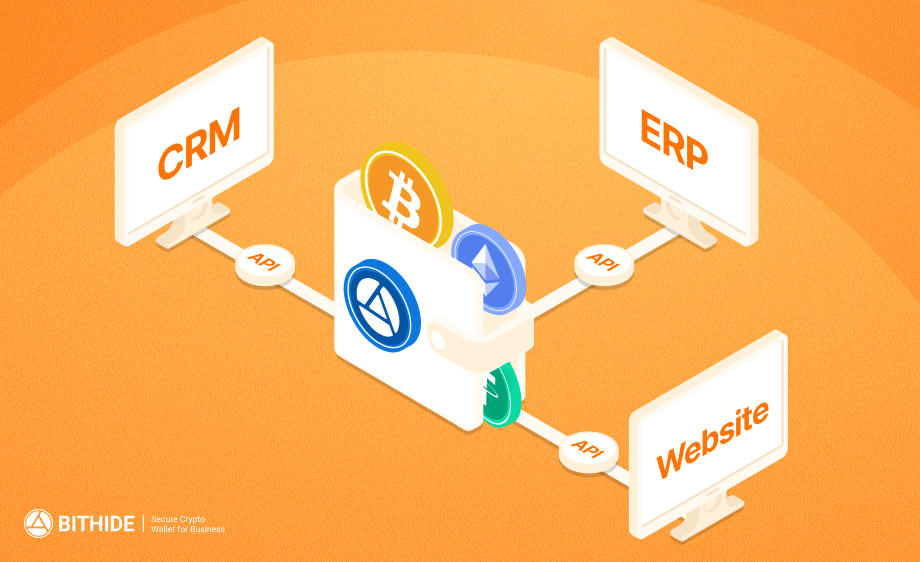
Integrating a crypto wallet into the company’s ERP, CRM, and other systems makes it possible to embed crypto payments into existing business processes without rebuilding them. This is especially important for companies where financial operations are tightly connected to accounting, sales, and day-to-day operations.
API support and integration mechanisms make it possible to automate payments, synchronize data, and minimize manual work. As a result, the crypto wallet becomes part of the company’s unified financial infrastructure rather than a standalone tool.
8. Can a Unique Address Be Generated Automatically for Each Payment?
Automatic address generation makes it possible to separate incoming transactions by source and simplifies tracking and reconciliation within business processes. For a business, this is critical from an accounting and operational control perspective: each transaction becomes clearly tied to a specific event or client, which simplifies audits, reduces the risk of errors, and improves the manageability of financial processes.
9. Does it Support Multiple Wallets and Subaccounts?
Support for multiple wallets and subaccounts is a key element of scalable corporate infrastructure. It allows a business to separate financial flows logically and operationally within a single company.
This is especially important for companies with multiple business lines or products: funds do not get mixed, while accounting and control remain transparent. As a result, the company gets a more manageable structure, simpler audits, and lower operational risk as it scales.
10. Does it Support Gas Management or Fee Optimization?
Blockchain fees are a direct operating expense that scales with transaction volume. That makes the ability to manage gas costs not an “extra feature,” but a real cost-optimization factor.
In BitHide, for example, on the TRON network, transaction fee expenses can be reduced by up to 50% through Energy rental. This is especially noticeable in scenarios with frequent payouts and large numbers of transactions, where fee optimization has a measurable impact on the overall financial model.
11. Are There Tools for Transaction Accounting and Reporting?
How is cryptocurrency different from traditional finance? There are differences, of course, but the ability to work with proper reporting should not be one of them. For a business, what matters is not the type of asset, but the ability to maintain transparent accounting and control over transactions.
Financial and operational reporting in a corporate crypto wallet should provide full visibility into fund movements, transaction statuses, and the entire financial infrastructure — comparable to what businesses expect from traditional financial systems.
All reports should be generated without restrictions, easily exported to Excel and CSV, and transferred to CRM and ERP systems via API, enabling crypto payments to fit into standard accounting and analytics workflows.
12. Is There Logging and Auditability for All Operations?
Comprehensive logging and auditability are essential for controlling a company’s financial infrastructure. The system should record every action: transaction initiation, status changes, approvals, user actions, and administrative operations.
This approach makes it possible to reconstruct the full chain of events, monitor team activity, and conduct internal reviews without losing data. For a business, it is a key tool for transparency and control in crypto operations.
13. Is AML Screening Available for Addresses and Transactions: Both Automatic and Manual?
The tool should also make it possible to screen transactions before they are credited to the wallet. This gives the business the ability to reject suspicious funds at the point of entry and build clean, manageable liquidity.
14. What Automation Tools are Available?
Automation tools in a crypto wallet handle the most routine operations so the business does not have to spend time managing transactions manually. These usually include:
- Auto-withdrawals — funds are sent to a predefined address once a certain balance threshold is reached.
- Mass payouts for working with a large number of recipients.
- Automatic consolidation of funds from multiple addresses into a single internal address.
15. Is Live Support Available, and How Quickly Does It Respond?
Live support is a critical part of a crypto payment solution’s infrastructure, especially when dealing with real-time transactions.
In standard business practice, a company should have access to a live support channel where response times depend on request priority and SLA level. It is important that the team not only responds quickly, but is also able to investigate incidents and help with operational and technical issues without delays that affect the movement of funds.
Conclusion
A corporate crypto wallet should not complicate financial processes. It should make them more transparent, manageable, and predictable. The more control, automation, and integrations are available out of the box, the easier it is for a company to scale operations without increasing manual workload.
We hope this article has helped you better understand what a crypto wallet for business should look like and which criteria are truly worth paying attention to when making a choice.