Auto-Withdrawal of Cryptocurrency: How to Optimize Fund Management
How to reduce operational workload when working with cryptocurrency wallets.
 233
233 
As the volume of cryptocurrency transactions grows, managing fund withdrawals manually becomes increasingly inefficient. Teams have to constantly monitor balances, move assets between wallets, and ensure that large amounts do not remain in hot wallets.
Automatic crypto withdrawals solve this challenge through predefined rules. The wallet initiates transfers automatically when specific conditions are met, reducing the workload on teams and minimizing manual operations. In this article, we will explain how auto withdrawals work in non-custodial crypto wallet BitHide, how to configure sequential routing, set up transfers to cold storage, and automate network fee payments.
Key Takeaways
- Once the configured balance threshold is reached, auto-withdrawal transfers funds from the wallet to a specified address.
- Manual withdrawals are manageable at low volumes, but become harder to scale as transaction counts, wallet addresses, and operational teams expand.
- In BitHide, you set a fund limit per coin. Hit it, and the cryptocurrencies go to an address you set in advance.
- Withdrawals can run once or loop, firing again every time the limit is reached.
- Funds can rotate across several addresses in order, or always go to one.
- A looped sweep to cold storage keeps hot balances small automatically.
- With BitHide, network fees are handled automatically, and Energy rental can reduce costs on TRON by up to 50%.
- Auto-withdrawals are especially valuable for crypto exchanges, OTC desks, e-commerce platforms, payment service providers, and IT teams that manage recurring payouts.
What Is Automatic Withdrawal in a Crypto Wallet
Manual fund management works well when transaction volumes are low. Balances grow gradually, and large amounts accumulate only occasionally. When the amount of funds exceeds what you are comfortable keeping in a hot wallet, moving them to cold storage is straightforward.
As the business grows, however, you are no longer dealing with a single wallet, but with dozens of them. Transaction volumes can reach hundreds or even thousands. Under these conditions, even a dedicated employee cannot maintain round-the-clock oversight. This is where auto-withdrawals and other crypto wallet automation features become essential. Without automation, manual processes start to limit the business’s ability to scale.
The Problem with Manual Crypto Withdrawals at Scale
Manual fund management is fine when you're handling a handful of transactions. You see the balance, you move it, done.
The trouble starts when the operation grows. Funds land on a hot wallet, and a hot wallet isn't where significant sums should sit, even when the wallet is non-custodial and well secured. So someone has to keep pulling those balances into safer storage or onward to operational addresses. Multiply that by dozens of wallets and hundreds of incoming transactions, and the manual approach turns into constant supervision.
How Auto-Withdrawal Works: Step-by-Step
BitHide includes an automated withdrawal mechanism for managing asset storage and liquidity flows. You define a balance threshold for a specific cryptocurrency in a selected wallet. Once the balance exceeds this threshold, the system automatically initiates a withdrawal to a preconfigured address.
If needed, you can add multiple addresses and configure cyclical withdrawals. In this case, the order is preserved: the first auto-withdrawal goes to the first address, the next to the second, and so on. This automates consolidation, reduces operational risk, and helps lower network fees by reducing the number of small, fragmented transactions.
Step 1 — Set a Fund Limit on the Address
Choose a wallet and the required cryptocurrency, then set a limit for auto-withdrawal. Once the balance reaches this value, the funds will be transferred to a predefined address.
Step 2 — Define the Destination Address
Choose where the funds should be sent. You can choose a single address for continuous withdrawals or multiple addresses between which the assets will be distributed sequentially.
Step 3 — The Wallet Triggers the Transfer Automatically
When the balance reaches the configured threshold, the auto-withdrawal mechanism initiates the transfer without user involvement. This demonstrates how recurring crypto payments work through predefined automated rules.
Step 4 — Transaction Confirmed on the Blockchain
After the transfer is sent, the transaction goes through the standard blockchain confirmation process and is recorded on the ledger like any other cryptocurrency transaction.
Sequential Auto-Withdrawal: How to Rotate Between Multiple Destination Addresses
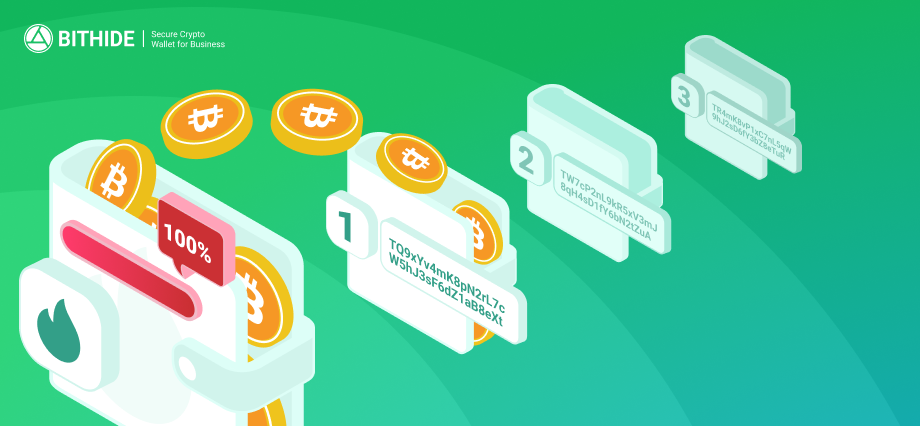
In BitHide, you can withdraw funds sequentially to multiple addresses. Each time the amount of cryptocurrency exceeds the defined threshold, the wallet sends it to the next address in the user-defined list. Once the list is exhausted, the withdrawal starts again from the first address if the auto-withdrawal repetition option is enabled, or stops if it is disabled. This mechanism can also be viewed as a form of scheduled crypto payments, where fund distribution follows a predefined sequence instead of manual execution.
A practical example: incoming funds can be distributed among separate addresses associated with different parts of the business, such as operational expenses and reserves, with each address receiving funds in turn.
Auto-Withdrawal to Cold Wallet: Best Security Practices for Business
The most common security use for auto-withdrawal is keeping balances on hot wallets low by regularly moving funds into cold storage.
Why Cold Wallet Auto-Transfer Matters for Business Security
A hot wallet is online and connected to the network, which is exactly why it is not suitable for holding large balances. Operationally, the approach is simple: keep only what is needed for day-to-day activity on the hot wallet, and move the surplus into cold storage where it is not exposed to live operations.
Doing this manually is easy to postpone. Teams get busy, balances accumulate, and the hot wallet can end up holding far more than intended by the end of the week. An automated rule removes this gap. The transfer to cold storage happens whenever the defined threshold is reached, regardless of manual intervention.
From a security standpoint, this raises a common question: are automatic crypto transactions safe. In practice, safety depends not on whether the process is automated, but on how strictly the rules are defined and how well the system is isolated from manual errors. When configured correctly, automation reduces risk by removing human delay and inconsistency.
How to Set Up Automatic Hot-to-Cold Transfers
The setup follows the same auto-withdrawal flow, and is one example of how to automate crypto transfers in a controlled environment. The destination is set to a cold wallet address, while a balance threshold is defined for each coin on the hot wallet.
Choose the threshold based on actual operational needs: low enough to minimize exposure, but high enough to avoid unnecessary transfers and network fees. From there, the rule runs in the background without intervention.
How Auto-Withdrawal Handles Network Fees Automatically
Blockchain transactions require the payment of network fees, so an automated fund transfer system must account for this to eliminate the need for manual gas top-ups. BitHide handles this in two ways.
Gas Stations: Automatic Fee Payment in TRON, ETH and BSC
Gas Stations are temporary addresses used to automatically cover network fees for outgoing transactions on the TRON, Ethereum, and BSC networks in the native cryptocurrencies of these blockchains. You only need to monitor the Gas Station balance and top it up in time.
How Energy Saves Up to 50% on USDT TRC-20 Withdrawal Fees
In BitHide, for USDT transfers on the TRC-20 network, you can use rented Energy instead of burning TRX, which allows you to save up to 50% on blockchain fee payments. At high payout volumes, reducing the fee on each USDT TRC-20 withdrawal results in a noticeable decrease in operational costs.
Who Needs Crypto Auto-Withdrawal
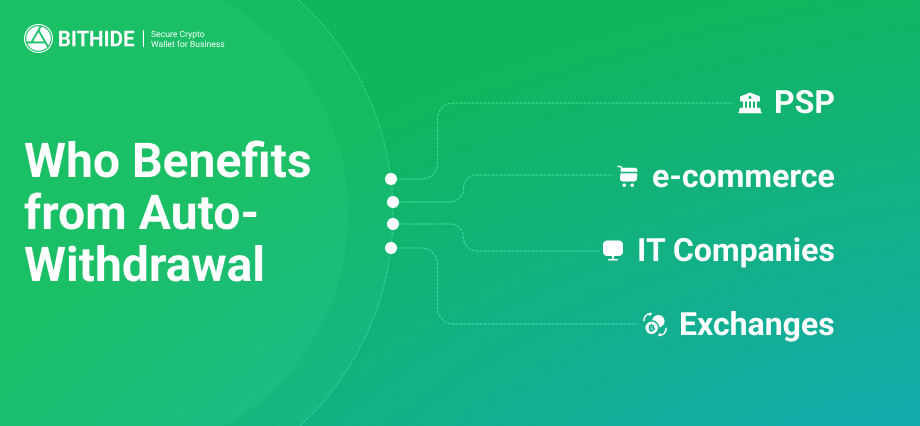
Auto-withdrawal earns its place wherever funds arrive constantly and have to be consolidated without a person watching over the process. Most of these teams also connect the wallet to their own systems through API integration, so withdrawals fire as part of a larger automated flow.
Crypto Exchanges and OTC Services
Businesses receive funds across a large number of addresses and require continuous consolidation for secure storage. The wallet automatically transfers excess assets to cold storage or treasury addresses.
E-Commerce Platforms Accepting Crypto
Platforms accepting crypto generate a steady stream of incoming payments. Auto-withdrawal pulls those receipts off working wallets and into settlement or storage addresses on a schedule that matches sales volume.
Payment Service Providers (PSP)
PSPs move other people's money at scale, which makes manual handling both slow and risky. Automatic crypto withdrawals let a PSP route funds to the right destinations by rule, keeping working balances controlled and the process consistent across high volume.
IT Companies with Recurring Payouts
Companies that regularly handle payouts to contractors, partners, and affiliates see clear advantages from automation. It removes human error and improves both speed and operational efficiency.
Auto-Withdrawal vs Manual Consolidation: Full Comparison
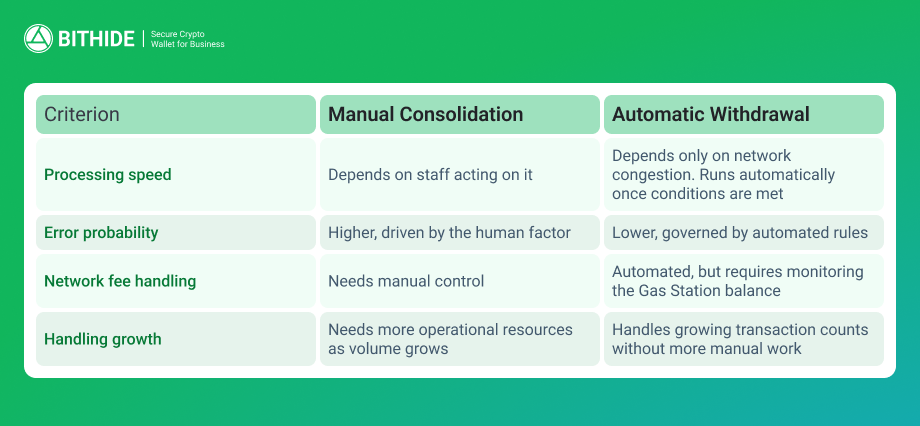
Crypto auto-withdrawal shifts fund management from manual operations to a predictable rule-based system. It reduces operational workload, improves control over liquidity, and makes processes scalable without expanding the team.
FAQ: Crypto Auto-Withdrawal
What triggers an auto-withdrawal in a crypto wallet?
A balance threshold. You set a fund limit for a specific coin on a wallet, and when the balance reaches that limit, the wallet automatically initiates the transfer to your chosen destination.
Can I auto-withdraw to multiple addresses at once?
You can auto-withdraw to multiple addresses in sequence. Each time the rule fires, funds go to the next address in your defined priority order, or you can set everything to go to one fixed address every time.
Is auto-withdrawal safe for large business volumes?
It's built for them. So, are automatic crypto transactions safe at scale? It comes down to control and design: in a non-custodial, self-hosted setup, the keys and funds stay under your control, and automating the transfers removes the manual errors that grow with volume. Moving surplus into cold storage automatically also keeps hot balances small.
How are network fees paid during auto-withdrawal?
Automatically. Gas Stations cover network fees for outgoing transfers in TRON, ETH, and BSC. For USDT TRC-20 transfers, you can optionally use rented TRON Energy to reduce network fees by up to 50%.
What is the difference between auto-withdrawal and a crypto sweep?
These mechanisms partially overlap. A sweep typically refers to transferring all funds from one or multiple addresses to a central wallet. Auto-withdrawal is an implementation of this concept based on rules: it transfers the full balance once a predefined threshold is reached to a specified address, can run as a one-time or recurring process, and also automatically handles network fee payments.