How to Store Your Seed Phrase Properly and Keep Your Assets Safe
Where to safely store your seed phrase.
 1263
1263 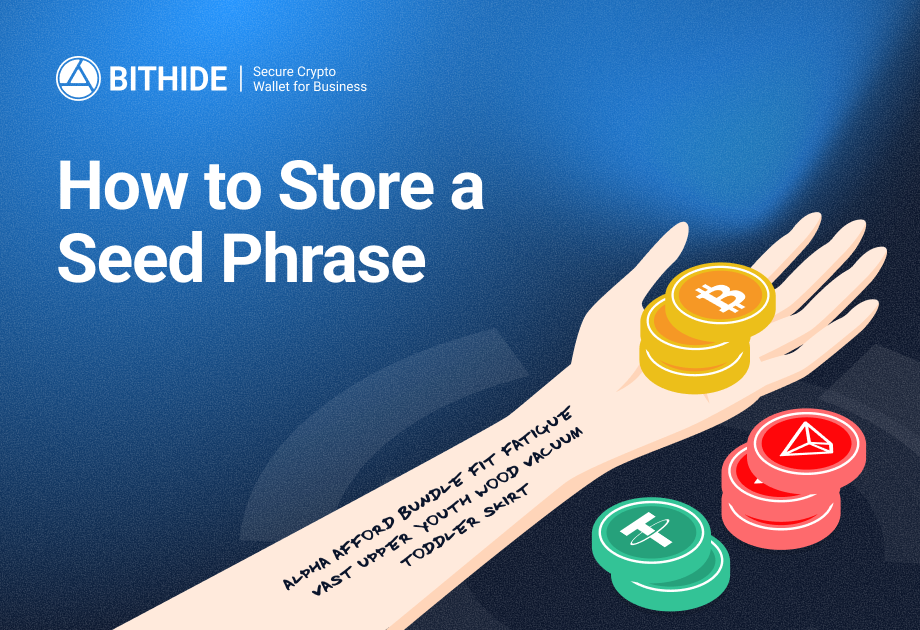
You can forget your email password and reset it with a "Forgot password" button. You can lose your bank card and order a new one. But if you lose or expose your crypto wallet seed phrase, no one can help you recover your funds. Blockchain has no support team, no recovery button, no hotline — and every transaction is irreversible.
In this article, we'll break down what a seed phrase is, what storage options exist, how they differ, and which one is the safest for businesses and everyday users. We'll also share real cases of losses worth millions of dollars caused by careless handling of seed phrases.
Key Takeaways
- According to Chainalysis, as of 2026, around 20% of all Bitcoin ever mined is considered permanently lost.
- A seed phrase is 12 or 24 English words generated when you create a crypto wallet. It's the only way to regain access to your funds.
- Paper storage is a simple and relatively safe option, since the phrase stays offline and can't be compromised remotely. However, paper is vulnerable to physical damage.
- A metal backup is a more reliable offline storage option. Steel or titanium plates don't burn or get damaged by water.
- Digital storage is the riskiest method. Screenshots, cloud services, email drafts, and password managers are all easy to compromise.
- Shamir Backup lets you split a seed phrase into multiple parts, eliminating a single point of failure — but it requires storage discipline and a clear understanding of the recovery procedure.
- Recommendation for individuals: use a metal offline backup, keep copies in two separate locations, and never create a digital copy of your seed phrase.
- Recommendation for businesses: implement multisig or distributed storage models with regulated access and internal controls.
The Price of Negligence: Bitcoin Graveyard Statistics
According to the analytics firm Chainalysis, as of 2026, approximately 20% of all Bitcoin ever issued — more than 3.8 million BTC — is considered permanently lost. At current prices, that's hundreds of billions of dollars locked in digital space due to basic human error:
- Users lose their seed phrases. James Howells from the UK, for example, has spent 13 years trying to get permission from authorities to search a landfill for a discarded hard drive containing the private key to an address holding 8,000 BTC.
- People die without passing on their crypto access credentials to heirs.
What Is a Seed Phrase and Why Does It Matter
A seed phrase is a set of 12 or 24 English words generated when you create a crypto wallet. At first glance, nothing special. But these words give you complete control over your crypto assets.
Behind this is the BIP-39 standard, which describes how a word set is generated from a special dictionary of 2,048 words. When you create a crypto wallet, the software randomly selects 12 or 24 words from this dictionary. That sequence is your master key.
Example of a 12-word seed phrase:
| alpha afford bundle fit fatigue vast upper youth wood vacuum toddler skirt |
If the seed phrase is lost, recovering access to funds is impossible. If it falls into the wrong hands, the attacker will transfer your assets instantly and irreversibly — no exchange or wallet developer can cancel such a transaction.
The question of how to store a seed phrase safely is worth asking before any significant amount of funds lands in your wallet.
Seed Phrase Storage Options: From Paper to Shamir Backup
Paper
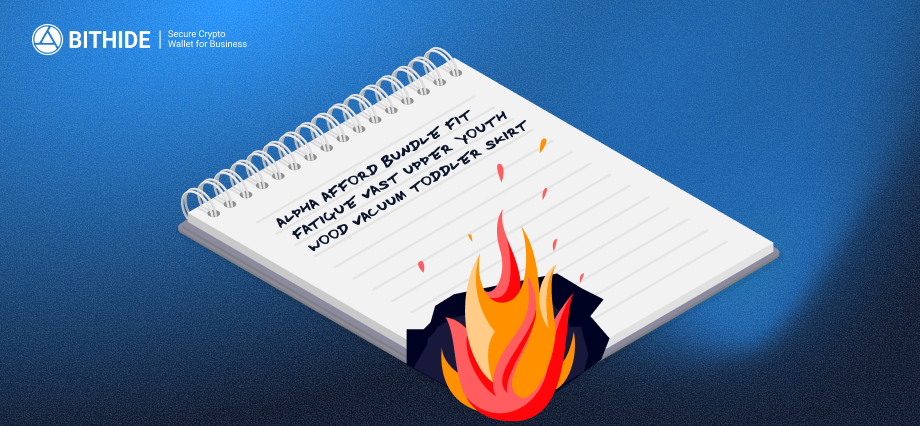
The simplest and most accessible method. You write the words on a sheet of paper and put it somewhere safe. Storing a seed phrase offline on paper is suitable for small amounts and beginners.
Pros:
- No internet connection means no risk of remote compromise.
- No additional hardware required.
Cons:
- Paper is easily destroyed by fire, flooding, or ink fading over time.
- It can be photographed or copied if someone gains physical access.
If you choose this option, use archival paper and waterproof ink. Don't store the note in obvious places like a desk drawer or a book on a shelf. And most importantly: never photograph the written phrase.
Metal Seed Phrase Backup
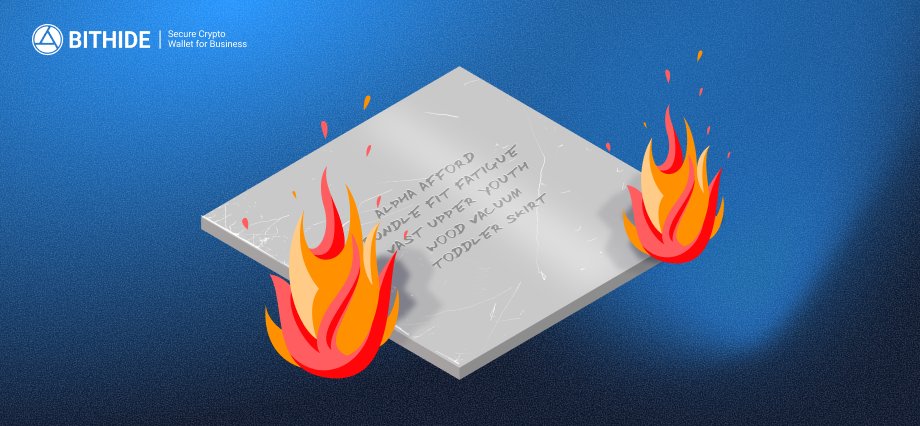
A more reliable version of offline storage. Words are engraved, stamped, or assembled from letter tiles on a metal seed phrase plate made of stainless steel or titanium. This type of storage withstands temperatures above 1,000 °C, is waterproof, and doesn't degrade over time.
Pros:
- Resistant to fire, water, corrosion, and physical wear.
- Durable: lasts for decades without any maintenance.
Cons:
- More expensive than paper (from $30 to $200+ for a quality solution).
- If an attacker finds the plate, they gain full access — just as with paper.
A metal seed phrase backup is optimal for significant amounts. If you're storing the equivalent of several thousand dollars or more, this is the minimum level of protection you should have.
Digital Storage
The best seed phrase storage approach for digital environments is one of the most debated topics in crypto security — and for good reason. Storing a seed phrase digitally is the most dangerous option, but it can be justified under strict conditions. This means using password managers with end-to-end encryption (where only you, not the service, can access your data), encrypted offline files, or air-gapped devices with no internet access.
Mandatory conditions for digital storage:
- Encryption no weaker than AES-256 standard.
- No automatic cloud sync (iCloud, Google Drive, Dropbox).
- Storage on a separate device with no internet connection.
- Regular file integrity checks.
If even one condition is not met, digital storage becomes an open door for hackers. According to OWASP international security standards (a community of software security experts), storing sensitive data in plaintext is considered a critical vulnerability.
Shamir Backup: Splitting the Phrase Into Parts
Shamir Backup (the SLIP-39 standard developed by SatoshiLabs) allows you to split a seed phrase into multiple shares. Recovery doesn't require all shares — only a defined threshold: for example, any 2 out of 3, or 3 out of 5.
This eliminates a single point of failure. Even if one share is stolen or destroyed, an attacker cannot reconstruct the wallet — but you can, using the remaining shares.
The downside: the scheme is more complex to set up and requires discipline. Among the most practical seed phrase security tips for this approach: each share must be stored in a separate location, and everyone involved in the storage process must understand the recovery procedure. For an average user this may be overkill, but for businesses or large holdings it's one of the most reliable approaches available.
Losing a Seed Phrase: Consequences and Real Cases
It's not only beginners who treat seed phrases carelessly — experienced users with large portfolios make the same mistakes.
Case 1. 7,002 BTC, a Forgotten Password, and 10 Attempts
Programmer Stefan Thomas received payment for his work in Bitcoin back in 2011, when one BTC was worth a few dollars. The private keys were stored on an encrypted IronKey hard drive, and the password was written on a piece of paper that Thomas later lost. The drive allows only 10 password attempts before locking permanently. Eight of those ten attempts have already been used.
Case 2. A Fake Browser Extension
In late 2025, attackers released a fraudulent update to the Trust Wallet browser extension that asked users to enter their seed phrase. The malicious code transmitted the phrases to hackers. Total losses are estimated at $6–7 million, with individual users reporting losses of hundreds of thousands of dollars.
Case 3. A Seed Phrase in Gmail Drafts
A user stored their seed phrase in an email draft folder. Hackers gained access to the account and withdrew 163 ETH — approximately $570,000 at the time of the theft. This case is described in detail in the Ledger Academy series «How I Got Hacked».
Every one of these situations could have been prevented — by not sharing the phrase with third parties, not entering it into unverified apps, and not relying on a single paper copy.
How to Protect Your Seed Phrase: Recommendations
It all depends on who you are: an individual investor or a company. The threats are different, and so are the approaches.
For Individuals: Digital Hygiene
If you're storing personal savings, your main enemy isn't a hacker attack — it's your digital footprint.
- No cloud storage. Never screenshot your seed phrase or save it to iCloud, Google Drive, or Telegram. Malicious software can scan smartphone photo galleries and identify 12 seed words in a fraction of a second.
- Use the «25th word» scheme (Passphrase) — a feature supported by most hardware wallets (Ledger, Trezor) and many software ones. You create an additional word yourself and enter it in a special field during wallet setup or recovery. It's never written down anywhere — it lives only in your memory. After that, all funds are stored at addresses generated only by the combination of your 24 words and the passphrase. Even if an attacker finds your steel plate and enters all 24 words, they'll open an empty wallet — without the 25th word, the seed phrase is useless.
- The two-location rule. Keep the primary phrase at home in a safe, and store a backup copy (or the 25th word) in a separate, reliable location: with a family member, in a safety deposit box, or in another city.
- Use a metal backup. Paper burns, gets wet, and fades. A steel or titanium plate will survive both fire and flooding.
- Never create digital copies. Not in notes apps, not in password managers, not in email drafts.
For Businesses: Corporate Control
In a business context, the main threat isn't an external hacker — it's the human factor inside the company. An employee leaving, a mistake, or malicious intent. A seed phrase in the hands of a single person is a vulnerability.
- Multisig (multi-signature): transaction confirmation requires signatures from multiple parties — for example, 3 out of 5 trusted individuals (CEO, CFO, legal counsel). Even if one key is compromised, the funds remain secure.
- MPC (Multi-Party Computation). A modern approach in which the key is split into encrypted shares distributed across servers and employee devices. A single unified phrase never exists at all.
- Institutional custodian. If company assets run into the millions, it makes sense to use licensed custodians (Coinbase Custody, BitGo) who assume legal responsibility for the safety of funds.
- Distribute responsibility. No single employee should have full access to funds. Establish a policy with clearly defined procedures and an audit trail.
- Two-factor authentication on all linked accounts. This is the bare minimum — and it's surprisingly often overlooked.
What You Should Never Do
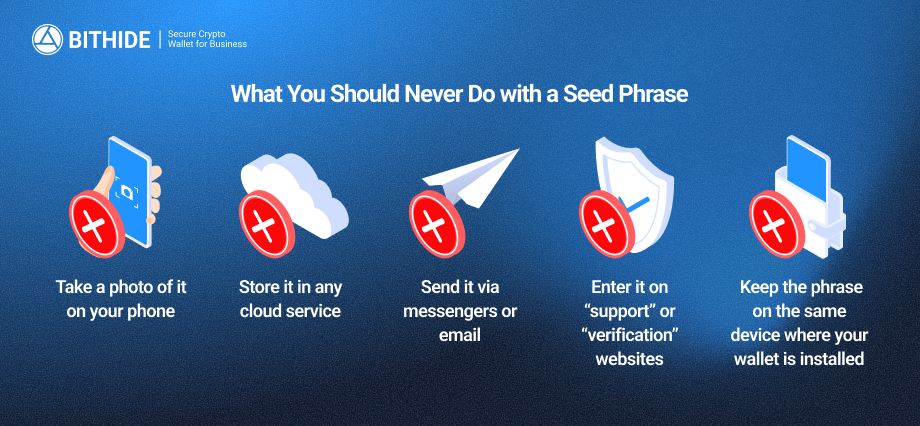
We've covered how and where to store a seed phrase safely. Now for the absolute don'ts:
- Photographing your seed phrase or saving it to Google Drive, iCloud, Dropbox, or any other cloud service.
- Sending it via messengers, email, or chat.
- Entering it on any «support» websites or for «verification» purposes.
- Storing it on the same device where your wallet is installed. That's like writing your PIN directly on your bank card.
Knowing how to store a seed phrase safely is the foundation of responsible crypto ownership. Crypto wallet security isn't built on a single action — it's a system of habits. Remember: in the blockchain world, there is no «Recover Access» button. Losing a seed phrase has irreversible consequences. You are the only one responsible for the safety of your assets.
Conclusion
All of the storage options discussed come down to one principle: minimize the risks of physical loss and digital compromise. Ultimately, the best way to store a crypto seed phrase is to combine physical security with a well-thought-out access strategy. Paper works for small amounts, metal increases resilience to physical threats, and splitting the phrase eliminates the single point of failure. The larger the assets, the more carefully designed the protection architecture needs to be.
For businesses, the stakes are even higher. This is no longer about personal discipline — it's about systematic access management, distributed responsibility, and protection from both internal and external risks. Understanding how to protect a recovery phrase at the organizational level means going far beyond individual habits. The question of where to store a crypto recovery phrase becomes a matter of corporate policy: one person, one seed phrase, one wallet — that's a vulnerable model. Companies need multisig and clearly defined role separation.
To learn more about securing your business's crypto operations, reach out to the BitHide non-custodial wallet team.